
Final Fantasy X Review
A deeply personal favourite whose story, music and readable turn-based battles remain powerful after twenty-five years.
Go to game entry →Watch original video review →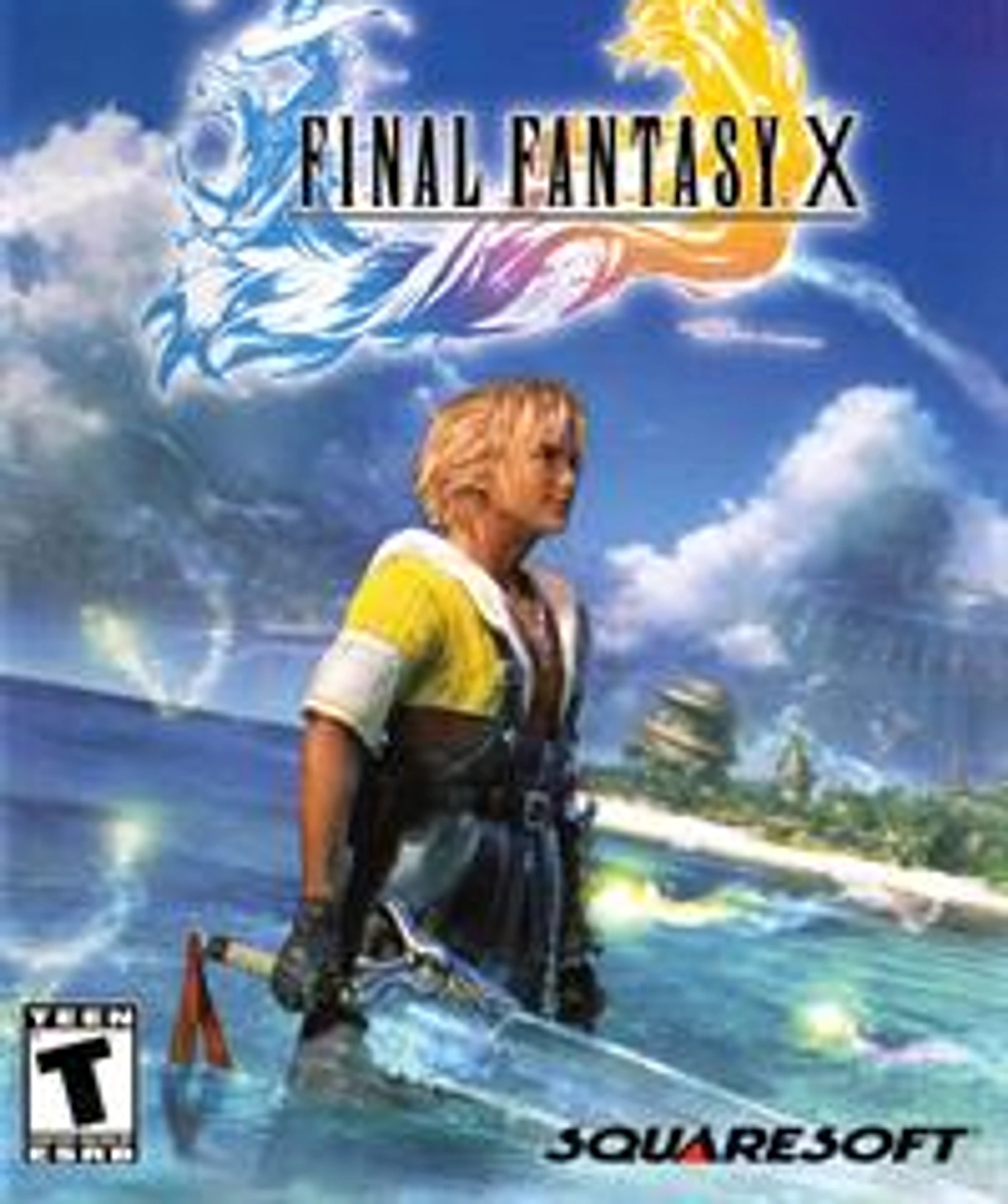
The verdict
Final Fantasy X helped pull me properly into Japanese RPGs, and that personal connection has not faded. I still remember its characters, its ending and the music that accompanied them. That is why it remains S tier for me, even though the pilgrimage is linear, some optional tasks are miserable and early voice direction has aged.
The best qualities are exactly the ones I value most: a story with emotional consequences, a cast I care about and a turn-based system that makes decisions understandable without making them trivial.
Spira, faith and the people living with fear
Sin shapes almost every part of life in Spira, and Yuna's pilgrimage gives its people a way to make sense of that threat. Tidus arrives as an outsider who does not know which traditions to accept, allowing the game to question faith, sacrifice and inherited expectations through conversations rather than constant exposition.
Yuna's resolve is the emotional centre. Tidus grows because he keeps asking uncomfortable questions. Auron's presence, Wakka and Lulu's attachment to Besaid, Rikku's challenges to convention and Kimahri's quiet loyalty make the group feel like companions instead of combat slots. Tidus and Yuna's relationship develops gradually, giving the story's most moving moments the weight they deserve.
Turn-based combat that still feels modern
Conditional Turn-Based combat makes the upcoming action order visible and shows how decisions affect it. Switching party members during a fight is immediate and useful, especially early when enemies encourage specific character strengths: Wakka's accuracy, Auron's armour-breaking force, Lulu's magic or Tidus's speed.
Aeons add controllable summons and tactical options, while the Sphere Grid supplies constant small rewards before eventually allowing radical character builds. The battle system teaches through play and rarely obscures why a strategy succeeded or failed. It is accessible without being shallow.
A linear journey with a remarkable soundtrack
Final Fantasy X is not secretly an open-world game. Its route through Besaid, Kilika, Luca, Macalania and beyond is deliberately guided. I think that gives the pilgrimage real momentum, even though players who prize freedom may find it restrictive.
The weaker elements are mainly side activities: dodging lightning, certain chocobo tasks and some ultimate-weapon requirements test patience more than skill. Several trials interrupt the drama, and old-fashioned pauses or repeated sequences can grate. But the music is magnificent. 'To Zanarkand' can still bring back an entire scene in a few notes, and the broader score does just as much to define Spira.
Final thoughts
FFX's linearity and awkward optional content have always been there. They do not lessen how strongly I remember its story, party, battles and music. For me, S tier does not mean a game without flaws. It means a game whose best qualities remain powerful decades later, and Final Fantasy X is exactly that.